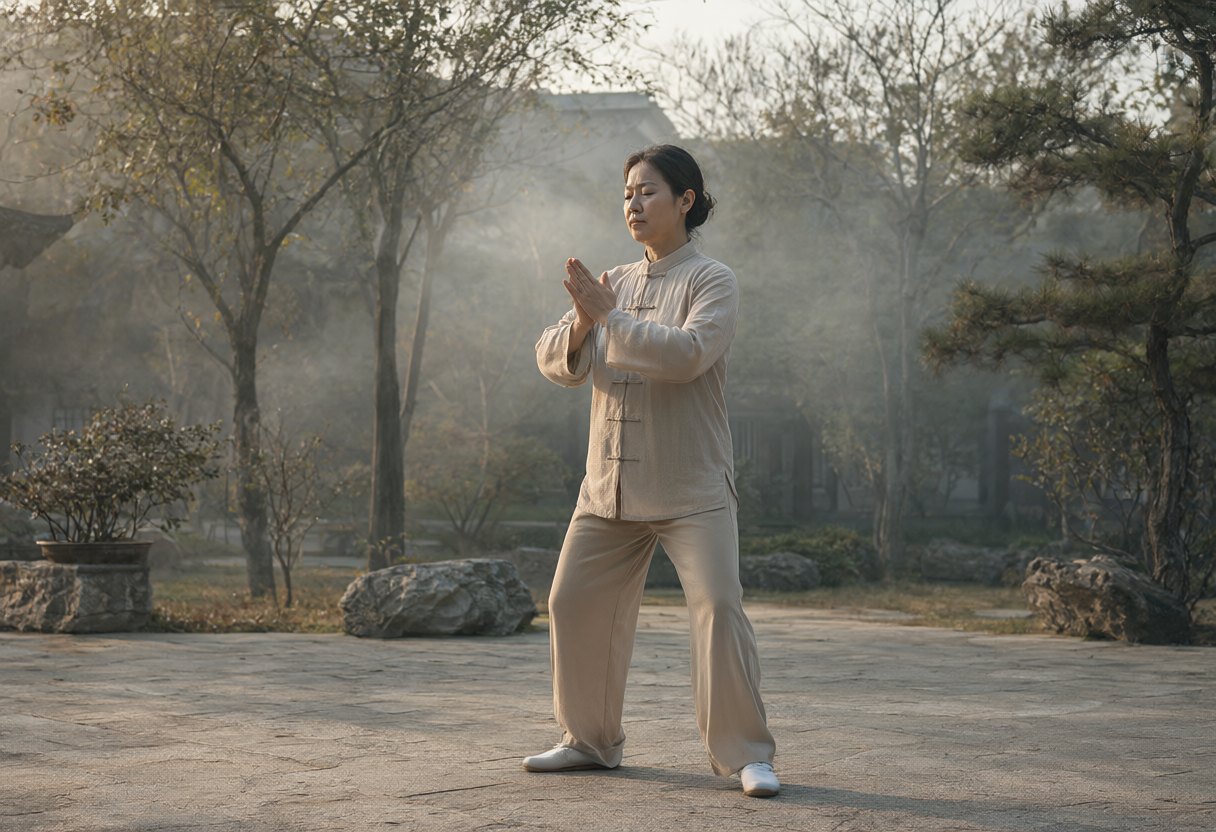

What Is the Dantian? The Body’s Energy Reservoir Nobody Taught You About
The dantian is the body’s central storage point for qi — a specific location below the navel that five thousand years of practice have identified as the place where cultivated energy accumulates and is held.
 By Onenergy Qigong Institute
In this article
If you have practiced any form of qigong, tai chi, or internal martial arts, you have probably heard the word dantian. An instructor gestured somewhere below the navel and said to bring your breath there, or to feel the warmth there, or to gather your qi there. And perhaps you nodded and did something in that direction, without a clear sense of what exactly you were trying to reach or why that location in particular.
That gap in understanding is not a minor footnote. What is the dantian is one of the most practically important questions in all of qigong — because without knowing what it is and what it does, most people practice qigong as a form of slow exercise, capturing only a fraction of what the practice is actually capable of. Naming the dantian and understanding its function transforms practice from approximate to intentional.
What is the dantian?
The dantian — written 丹田 in Chinese, pronounced roughly “dan-tyen” — translates literally as “field of elixir” or “cinnabar field.” The name comes from Taoist alchemy, where it referred to the place inside the body where the essential energy of life is stored and refined. Over millennia, as qigong developed out of those Taoist roots, the dantian became the central organizing concept of the practice: the place where qi accumulates, where it is held safely between sessions, and from which it can be drawn upon when needed.
There are traditionally three dantian in the body. The upper dantian sits at the center of the forehead — associated with consciousness, perception, and mental clarity. The middle dantian sits in the chest — associated with emotional life and the heart. The lower dantian, located roughly two to three finger-widths below the navel and a third of the way into the body, is the foundation. It is the storage vessel. When qigong practitioners speak about the dantian without specifying which one, they almost always mean the lower dantian.
This article focuses there — on the lower dantian — because that is where the daily practice of building and holding qi centers, and because that is the location most directly relevant to the question of energy, vitality, and the reservoir that qigong practice is designed to fill.
Where is the dantian?
The lower dantian occupies a zone in the lower abdomen — below the navel, above the pelvic floor, centered in the body front to back. It is not a discrete anatomical organ visible on a medical scan. Western imaging does not find it, which is not evidence that it does not exist — it means Western imaging was designed to map a different system. The dantian belongs to the qi system, which has its own architecture distinct from the blood and organ structures that Western medicine maps.
Finding the dantian through felt experience is a gradual process. In the early stages of practice, many people feel warmth in that region — a mild heat, sometimes a heaviness, sometimes a gentle pulsing. This is not imagination and not placebo: it is the qi system beginning to respond to directed attention and movement. The sensation develops with practice. A beginner working with the lower dantian for the first time may feel very little. Someone who has practiced for years can feel it as a clear, warm, stable presence — a fullness that is unmistakably different from a full stomach.
You verify this in yourself over time. No description substitutes for the felt experience.
What the dantian does: the reservoir function
The most practical way to understand the lower dantian is as a reservoir. The qi system circulates through meridian channels throughout the body — qi moves, it flows, it responds to movement and breath and attention. But circulating qi is not the same as stored qi. Circulating qi is like water flowing through pipes. The dantian is the tank.
In daily life, qi is continuously being spent. Physical exertion spends it. Emotional stress spends it. Sustained mental effort spends it. Poor sleep, poor posture, and scattered attention all leak it. If the reservoir is not being replenished, the level drops. And because the qi system is upstream of the blood system — qi failing quietly, years before anything shows up in a blood panel — most people are running a depleted dantian for a long time before any conventional measurement catches it.
Qigong practice replenishes the reservoir. The morning practice, specifically, is designed to direct qi into the lower dantian while the body is receptive. The movements, the breath patterns, and the focused inner attention all serve that filling function. The evening practice serves the assimilation function — what was gathered through the day settles back into the dantian and is stored, so that tomorrow begins from a slightly higher baseline.
This is why the classical image for the dantian in daily practice is savings — a little deposited every day, steadily accumulating over months and years into something substantial. The analogy is exact: small consistent deposits beat large irregular ones, and the effect of the accumulation becomes most visible not in any single day but across a season of practice.
The dantian and the practices that accidentally touch it
Here is something worth noting: many people have felt the dantian without knowing they were doing so. Long slow walks where the breathing drops naturally low and the mind goes quiet. Certain yoga poses where the attention lands below the navel. A few minutes of focused deep breathing in the morning. Moments of still, absorbed attention to something beautiful. These experiences produce a feeling of groundedness, of being settled in the body, of warmth in the belly, of a calm that is specifically physical rather than mental.
What is happening in those moments is that the practice — whatever it is — has accidentally activated the dantian area. The qi gathered slightly. The reservoir received a small deposit. The person felt it as “centered” or “grounded” without having a framework for what they were actually touching.
This is why naming the dantian changes practice. When you know what you are working with and where it is, the same movements that accidentally grazed the dantian before become deliberately targeted at it. The deposit becomes intentional. The accumulation accelerates. And practices that felt vaguely helpful before become clearly, specifically useful.
Dantian versus chakras: a brief note
People familiar with yoga or Ayurvedic medicine sometimes ask how the dantian relates to chakras — the energy centers of the Indian tradition. Both are organizing concepts for understanding the body’s energetic architecture, and both identify the lower abdominal area as significant. The lower dantian and the sacral chakra (svadhisthana) occupy roughly overlapping territory.
The two traditions are distinct, however, and should not be conflated without care. The chakra system is organized around seven centers distributed along the spine, with a particular emphasis on vertical energy flow and states of consciousness. The dantian system, in its Chinese form, is organized around three fields with a different functional logic — the lower dantian as the storage foundation, the middle as the emotional heart, the upper as consciousness — and a different set of practices designed to cultivate each.
Both are real maps of real territory, developed by different traditions over thousands of years. They are not the same map. If you are working in the qigong tradition, work with the dantian framework. If you are working in the yoga tradition, work with the chakra framework. Mixing them without depth in both tends to produce confusion rather than clarity.
Why the dantian matters for daily energy
The fatigue that drives people to search for answers is not always a blood chemistry problem. Often it is a reservoir problem — a lower dantian that has been running low for years, draining faster than it refills, until the baseline energy level that once felt ordinary is no longer accessible. The blood panel comes back normal because the blood system is downstream; by the time the blood shows a problem, the qi system has been struggling for a long time.
Real daily energy management, in the qigong framework, is largely a dantian management question. Is the reservoir being filled in the morning? Is what was gathered being assimilated in the evening? Are the daily leaks — stress, poor posture, scattered attention — being recognized and minimized? These are the practical questions that determine whether a person’s energy level is rising, holding, or slowly falling over the course of months and years.
Understanding the dantian is the beginning of being able to work with these questions intentionally, rather than just hoping the fatigue eventually resolves on its own.
Starting with guided practice
The lower dantian is not something you can fully understand through reading about it. The understanding comes through practice — through the accumulation of felt experience that lets you distinguish the dantian’s warmth and fullness from other sensations in the body. That takes time and good guidance.
The free Onenergy App offers daily guided qigong practices that work directly with the lower dantian — morning routines designed for filling, evening routines designed for assimilation, and beginner practices that introduce the felt sense of qi in the lower abdomen in a clear, structured way. If you want to know what the dantian feels like from the inside, the most direct path is guided practice rather than more reading.
For those who want to go further — to practice with Master Dai directly and understand the full structure of qigong’s energy system — the Onenergy Manifesto is a free live event where Master Dai teaches the principles that sit behind the daily practice. RSVP through the Onenergy App under Upcoming Events.