The Great Lie of Modern Healing
Half the wellness industry collapses the moment you see this. The other half does not yet know it.
There is a story underneath almost every piece of health advice you have been given for the past hundred years. The story has been so consistent, repeated by so many different professionals — doctors, nutritionists, fitness coaches, supplement brands, biohacker podcasters — that most people never notice it is a story at all. It is just assumed. Like water to a fish.
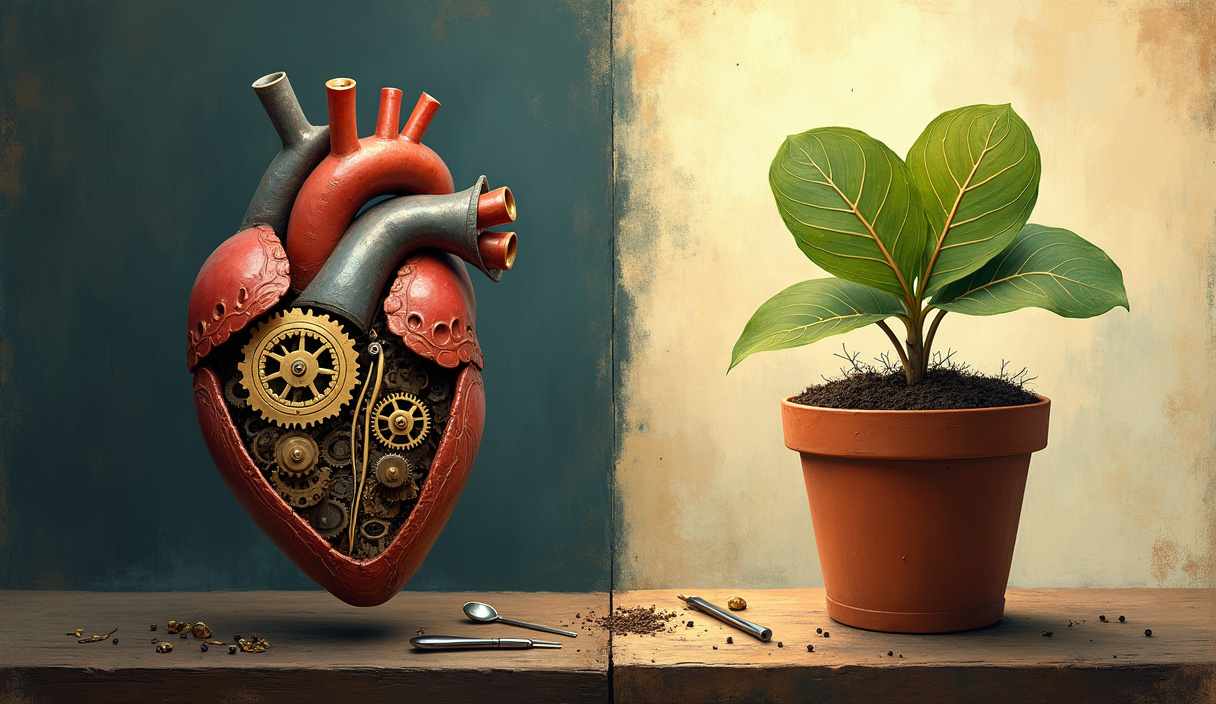
The story goes like this. Your body is a machine. It is made of parts. When a part goes wrong, the way to fix it is from the outside, with something you do to that part. A pill for the heart. A protocol for the gut. A supplement for the immune system. A treatment for the joint.
This is the great lie of modern healing.
And once you see it, you cannot un-see it.
The body is not a machine
A machine is assembled from outside. Someone gathers the parts, puts them together according to a blueprint, and the machine begins to work because it was constructed correctly. If something breaks, you open it up, replace the broken part, and the machine works again.
Now look at your body.
Nobody assembled you. There is no blueprint that was followed by a builder standing outside the system. You grew. From one single cell, by an intelligence that was already inside that cell, you assembled yourself into a body of about thirty trillion cells, organized into tissues, organs, networks of communication that we are still discovering after centuries of looking. The thirty trillion cells turn over many times in your lifetime. You are continuously being rebuilt — not from outside, but from inside, by the same intelligence that grew you in the first place.
This is a very different category of thing than a machine.
A machine was put together. You grew. A machine breaks when a part fails. The body is not made of parts in that sense — every part is in constant conversation with every other part. Cut yourself, and the body sends material to the cut without consulting a manual. It builds clot, then connective tissue, then new skin. The body knows how. It has always known how.
You did not learn this. Nobody assembled you. You grew.
In Chinese medicine this is the most basic observation about what a body is. The English language has the word organism, which means roughly the same thing, but the word fell out of common use in Western health discourse some time in the last century. We replaced it with patient. A patient is a thing being treated. An organism is a thing that lives.
Why the lie persists
If the body is so clearly a growing organism and not a machine, why has the machine model survived for four hundred years?
It survived because there is one very specific situation in which the machine model is useful — emergencies. A broken bone. A bleeding wound. An organ failure that is going to kill you in the next forty-eight hours. In those moments, modern medicine is genuinely without equal in human history. Surgery, antibiotics, trauma care — these are real achievements, and the machine model produced them.
The problem is what happened after. The same model was extended to chronic conditions, to wellness, to long-term health — situations where the body is not in emergency, where the body is in fact still doing its work, where what the body actually needs is the opposite of intervention. It needs material. It needs flow. It needs direction. None of those are things you can apply to it from outside the way you set a broken bone.
Modern medicine is what you want when you have been hit by a car. It is not what you want when you have been tired for three years.
The wellness industry noticed that modern medicine was failing the second category. Good. It should have noticed. But it did not change the underlying model. It built its entire offering on the same outside-in logic, just with prettier branding. A supplement instead of a pill. An adaptogen instead of an antidepressant. An ice bath instead of a treatment. The shape of the answer was identical: something done TO you, from outside, to fix a part.
This is not holistic. This is the same machine model with a kinder vocabulary.
Half the wellness industry depends on you not noticing this.
You do not have four problems
Here is what happens when you live inside the outside-in story for long enough.
You develop a collection of symptoms over the years. You sleep badly. You feel anxious in a way that did not used to be there. Your gut is unpredictable. There is a fog around your thinking that was not there in your twenties. You go to a sleep specialist for the first one, a therapist for the second, a gastroenterologist for the third, and an integrative doctor for the fourth.
Each one optimizes their window into your body. None of them looks at the room.
You do not have four problems. You have one problem with four windows. The room is one body, one network of energy and tissue and signaling, and that one network is in distress. The distress shows up at the four weakest points. A specialist for each window can give you a protocol for that window. None of them is wrong about their window. But the room is never looked at, because looking at the whole room is not a recognized specialty in the system you were handed.
The body itself sees the room. It has always seen the room. That is the part of you that knows.
A small experiment, right now
Stop reading for sixty seconds.
Sit where you are. Place one hand on your chest, one on your abdomen. Close your eyes if you can. Count one minute of breath. Do not control it. Do not deepen it. Do not slow it down. Just notice that the breath is happening to you, not from you.
While you are counting, notice three things.
One — you did not decide to breathe in. The breath decided for itself.
Two — your heart is beating without your involvement.
Three — there is warmth in your hands. The warmth was there before you noticed it. It will be there after you finish reading this.
Three intelligences, all running, none of them under your control. You are not the operator. You are the place where they are happening.
This is what the word organism used to mean.
What this changes
If you take the body-as-living-whole seriously for one day, the entire structure of your health decisions shifts. Not because you have learned new information, but because you are asking different questions.
You stop asking, what should I add? You start asking, what does the system need?
You stop asking, which part is broken? You start asking, what is the whole network telling me?
You stop asking, what is the protocol for this symptom? You start asking, what is the symptom telling me about the room?
These are different questions. They produce different lives.
You will still go to the emergency room when you break your arm. You will still benefit from a surgeon when you need a surgeon. But you will stop expecting modern medicine to do the thing it was never designed to do — restore the wholeness of a living organism through outside-in intervention.
And you will stop blaming yourself for not getting healthier on a protocol that was built on a wrong model.
You are not broken. The tool you were handed is broken. Those are very different sentences. The first one is what the system has been training you to say to yourself for years. The second one is what is actually true.
Where to go from here
The body is doing this work right now, while you read. The intelligence that grew you is the intelligence that heals you. The practice — what we teach as qigong — is how you stop interfering with that intelligence and start cooperating with it. It is not a new piece of information. It is a way of returning to a way of being that the human body has known for as long as there has been a human body.
If something in this piece landed in your body, not just your head, the next step is simple. Download the Onenergy App. Master Dai teaches the foundational practice live in the app every week — the schedule sits on the home screen, free, open.
You will be asked to test something in your own body. That is the only authority that matters here. Yours.
About Master Dai
Master Dai is an officially trained, certified qigong teacher with almost forty years of practice and teaching in this work. He founded the Onenergy Qigong Institute and built the Onenergy App to carry the wisdom of a five-thousand-year-old practice into a form a modern person can actually use. He teaches live in the app every week.
Related reading
– You Are Not a Machine — the body as living whole, in depth – Four Windows, One Room — why chronic symptom stacks are one problem, not four – You Are Not Broken. The Tool Was. — healing the self-blame the system produced