
Moving Meditation for People Who Can’t Sit Still
The instruction to sit still assumes the body is ready for stillness. For many people, it is not. The moving form of qigong — 动功 — is built for restless minds. Here is what it does, and why it works differently from the meditation you have already tried.
 By Onenergy Qigong Institute
In this article
You have probably been told that meditation means sitting still. Find a quiet place, close your eyes, watch the breath, let thoughts pass. Simple in theory. In practice, for a large portion of people, it produces nothing except the feeling that their mind is doing something wrong.
Here is the thing nobody usually explains: the instruction to sit still assumes something about the state of your body that may not be true. It assumes the body is ready for stillness. For many people — maybe most people living a modern, demanding life — it is not. And handing an unready body the instruction to be still does not produce calm. It produces restlessness, frustration, and the conclusion that meditation is simply not for certain kinds of people.
It is for those people that the moving form was designed.
Moving meditation: what it actually is
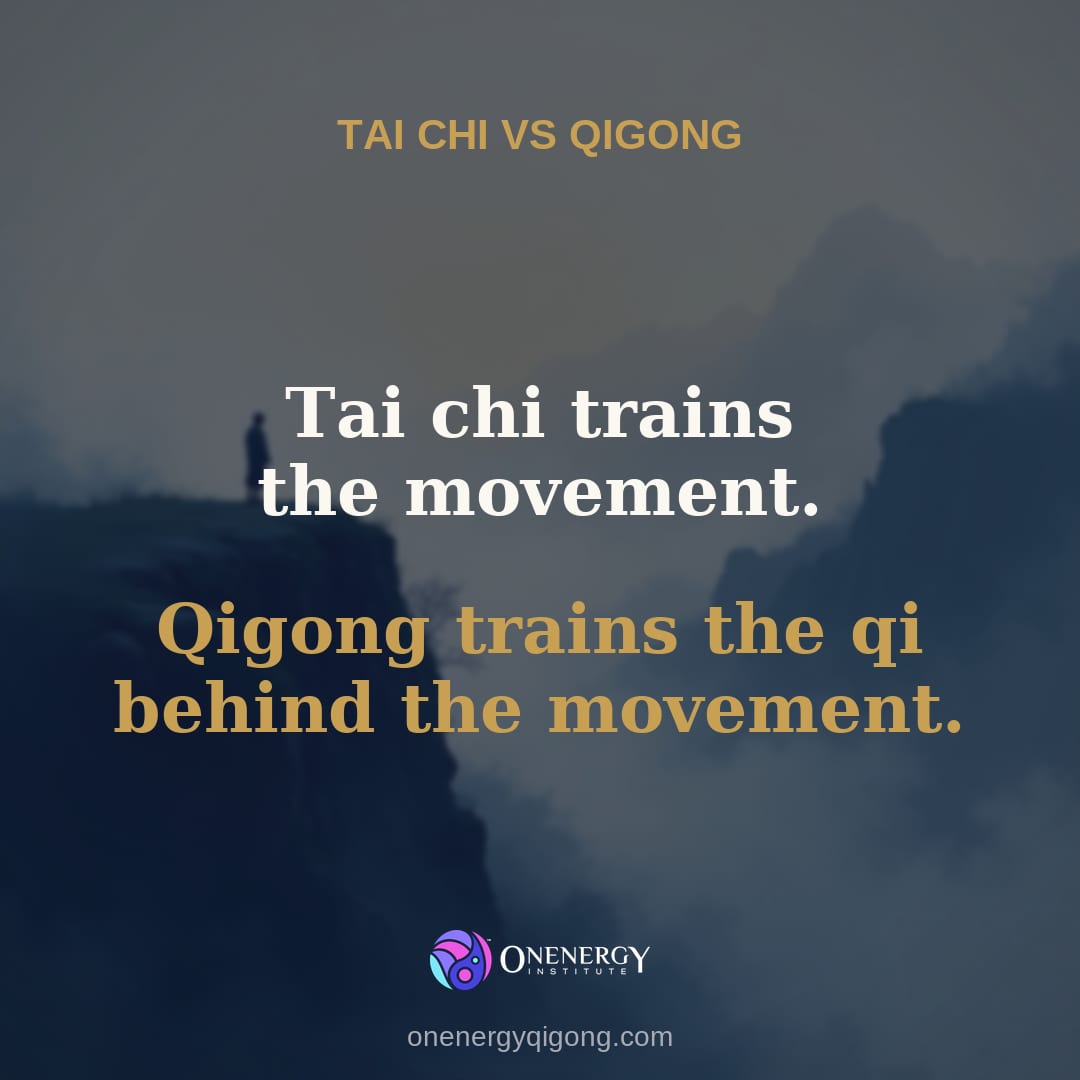
The term “moving meditation” is used loosely to describe a range of practices — walking slowly, mindful movement, tai chi, dance, and various forms of qigong. What unites them is the intention: instead of asking the mind to go quiet through force of will, you give the body something gentle and deliberate to do, and the mind settles as a consequence.
In qigong, the moving form is called 动功 — “moving cultivation.” It is one of the two foundational forms in the practice, alongside the still form (静功). Together they are not opposites; they are a sequence: moving first, still second. Build first, settle second.
What distinguishes it from ordinary exercise is what the movement is doing energetically. Most physical exercise spends the body’s energy. The moving form does the opposite: it gathers energy, opens the channels through which it flows, and leaves the practitioner stronger and more settled at the end, not depleted.
Meditation for people who can’t sit still: why you are not broken
The person who cannot sit still is not a failed meditator. In many cases, the restless mind and the restless body are pointing at something real: the system is running on not enough. A depleted, overstimulated nervous system does not become calm because it is told to. It becomes calm when the energy feeding it changes.
Sitting in silence on an empty tank gives the mind nowhere to go except inward into whatever tension was already there. This is why, for many people, the first few minutes of sitting meditation feel worse rather than better — the silence removes the distraction of activity and leaves the underlying state more visible.
The moving form does not ask you to overcome your restlessness. It uses it. The body is gently occupied with slow, intentional movement. The attention has something to follow — the quality of the movement, the breath, the sensation of energy shifting. And because the attention is engaged, the mind stops generating its usual noise on its own. Not through suppression. Through natural displacement.
This is the practical reason the tradition discovered, fifteen hundred years ago, that movement had to come before stillness. As the old Shaolin legend tells it, the monks could not hold deep sitting meditation because their bodies were too weak — movement came first to build the energy, and only then did stillness become possible.
What the moving form does — described, not taught
This post describes the moving form conceptually — not as instruction. The specific movements, their sequence, and the precision of attention involved belong in a teacher-led program. What follows is what the practice is doing, so you understand why it works differently.
In the moving form, the body moves slowly. Not slowly the way tired muscles move, but slowly the way water flows around a stone — with continuity and presence. Each movement is complete. There is no rush between positions, no reaching for the next thing. The quality of the movement matters more than its shape.
The breath and the movement are coordinated — naturally matched so that the in-breath and out-breath become part of the movement rather than running alongside it. When the mind wanders, the practice is simply to return attention to what the body is doing. The moving body gives the attention a clear landing place — something that forced silence, with its blank field, does not always provide.
Over time, this sustained, embodied attention is what trains the mind to settle — not through suppression, but through repetition. After a session of moving-form practice, sitting becomes genuinely easier. The restless mind has been given a different experience of itself, and the still form has a prepared body to work with.
Who the moving form serves best
The moving form is the natural entry point for people with busy minds, people who have tried sitting meditation and found it frustrating, and people whose daily lives involve significant stress. It is not a consolation prize for those who cannot manage the “real” thing. It is a distinct practice with its own depth.
People who describe themselves as unable to sit still often respond to moving-form practice quickly — perhaps because their restlessness is a sign of energy looking for somewhere productive to go. The moving form gives that energy a direction. What was excess becomes resource.
You verify this in yourself. The description only points at it. The only way to know is to do it.
Try the moving form with the Onenergy App
The free Onenergy App is built to guide you through moving-form qigong practice from the beginning — no prior experience required, no equipment, no particular flexibility. The guided practices are designed for real people with real schedules, starting where you actually are rather than where a practice assumes you should be.
For those who want to go deeper, Master Dai runs live events and a structured program — The Onenergy Way — where the moving and still forms are taught in their full context and sequence. The live setting lets you feel what the practice is doing in your own body, which is the only way to know it for yourself.