
Why Does Qigong Work? Gathered It Takes Form, Scattered It Becomes Wind
Why does qigong work? The tradition maps one governing property of qi: gathered, it takes form; scattered, it becomes wind. Here is the mechanism, explained plainly — with the boundaries that matter.
 By Onenergy Qigong Institute
In this article
People ask why does qigong work as though the question needs a complicated answer, and in one sense it doesn’t. Tradition maps a single governing property of qi, tested and refined over an extremely long time, and the whole practice rests on it. It is not a theory of everything. It is one property — and once you understand it, a great deal of what qigong actually does stops looking mysterious.
One property: gathered, it takes form. Scattered, it becomes wind.
There is an old line in the tradition: ju ze cheng xing, san ze cheng feng — gathered, it takes form; scattered, it becomes wind. Qi moves between two states. Concentrated and gathered, it becomes something with shape. Spread thin, it is invisible and moving, like wind — which you never see directly and never doubt exists, because you feel what it does.
This single property is the mechanism behind the question of why qigong works. Practice is, at its core, learning to move qi between these two states on purpose — gathering it where more is needed, and helping it move where it has become stuck or excessive.
The water you already understand
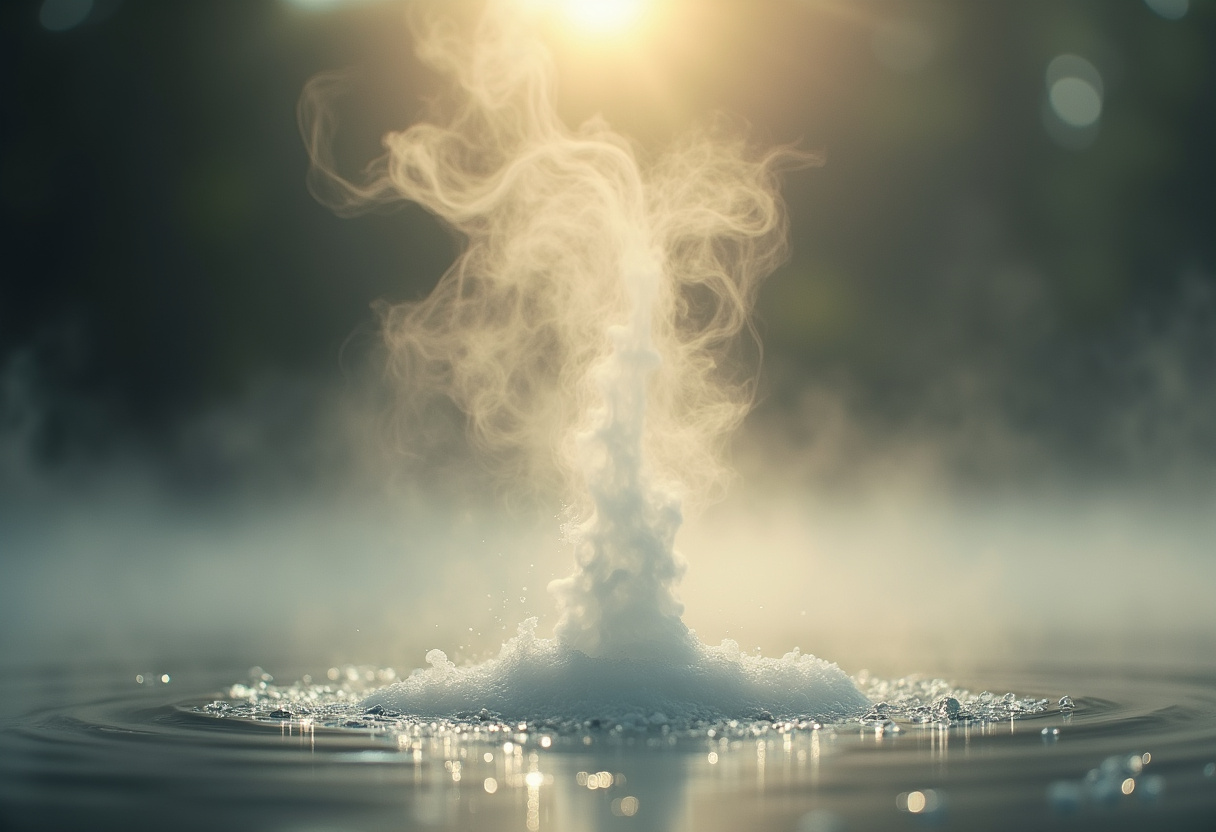
You already know this behavior, because water does the same thing. Steam fills a room and you cannot hold it in your hand. The same substance, cooled and gathered, becomes ice sitting in your palm. Nothing was added to turn steam into ice — only the gathering changed. Qi behaves the same way. Nothing needs to be added or invented. The state changes with how concentrated it is.
Knock on the table in front of you. It holds together, solid and unmoving, and nothing was added to make it solid — the atoms that compose it are, at the scale that matters here, simply gathered densely enough to hold a shape. Tradition applies the same logic one level further: your body is qi gathered into shape, and it holds that shape for as long as the gathering holds.
Two directions, one nature
Because qi moves in both directions, the practice works in both directions too. San ze cheng feng — scattered, it becomes wind — describes qi being dispersed. In this tradition, nothing takes physical form without first gathering at the level of qi. So where qi has gathered somewhere it should not, tradition’s model is that a mass is qi that gathered in the wrong place before it hardened into form. This is a description of the tradition’s model of how form arises — it is not a claim about any specific diagnosis, and it is not a claim that any mass or named disease shrinks or disappears through practice.
Ju ze cheng xing — gathered, it takes form — works the opposite direction. Where something in the body has been worn down, weakened, or has lost function, tradition holds that gathering qi there is how the body is supported in rebuilding it. One direction disperses what should not be there. The other direction builds what should be there. Neither direction is a technique someone invented recently — the practice simply follows a property qi is already understood to have.
A difference of level, not a competition
It is worth being precise about where qigong sits next to Western medicine, because the two are easy to place in false opposition. Western medicine works at the level of the finished, physical form — the tissue, the structure, the measurable result. Qigong works at the level of qi, the level tradition holds is prior to form. These are different levels, with different tools, doing different jobs. That is the entire comparison. It is not a statement that Western medicine fails, and it is not a claim that qigong replaces it. It is a difference of level, stated plainly, with no praise and no criticism attached to either side.
This is not a reason to refuse treatment, and it is not a promise of any outcome — decide your own care with your doctor. That sentence is not a legal formality tacked onto the end of an article. It is the honest boundary of what any single mechanism, however well mapped by tradition, can respectably claim for any individual reader.
Why this is the whole shape of the method
Put together, this is the entire logic behind why qigong works the way it does: the practice does not fight anything. It follows qi’s own nature — gathered, form; scattered, wind — and uses that nature in the direction it already moves. This is also why qi on its own is not the full picture. A quantity of qi with no order to it does very little. The meaningful difference is not qi against no qi — it is organized qi, qi with order and direction, against qi that has lost its organization. Gathering matters. What organizes the gathering matters just as much, and that is a deeper layer of the practice than one article can hold.
There is more to this mechanism than one property — why intention moves qi, why stillness feeds it, why it disperses under certain conditions and gathers under others. That is the material of a full, sequenced program rather than a single page. If this explanation of the mechanism is the piece you were missing, start with the free Onenergy app, and watch for the guided program — it walks through the properties of qi in full, in order, the way tradition actually teaches them.