Why You Feel More Tired as the Days Get Shorter — and a Simple Autumn Practice
You noticed it this week. The evening arrives earlier than it did a fortnight ago, the light in the afternoon has gone thin and slanted, and somewhere around three or four o’clock your energy drops out from under you. You are not sleeping badly. Nothing has changed at work. But you feel heavier, slower, and more like curling up than you did in August — and you cannot quite say why.
This is the body meeting a real turning point in the year. Around September 23 the year reaches the moment the Chinese seasonal calendar calls Autumn Equinox — 秋分 (qiū fēn), the day when daylight and darkness stand equal and the balance of the year tips, for the first time, toward the dark half. From here the nights are longer than the days, and they keep growing. Your body registers that shift before your mind gives it a name, and the first place you feel it is your energy.
Why shorter days pull your energy down
Think of the long days of summer as money coming in. Light arrives early, stays late, and your whole system runs on the assumption that there is plenty of it — you wake easily, you push through the afternoon, you stay up without trying. When the year turns at the equinox, the daily supply of light starts shrinking from both ends: later dawns, earlier dusks. Your body is still spending at the summer rate, and the account no longer refills as fast. The flat, heavy feeling in the afternoon is the first overdraft notice.
In the older Chinese understanding of the year, autumn is the season of gathering in — the harvest is brought under cover, the sap draws back down out of the leaves, and the natural movement of energy turns from rising and spreading to settling and storing. A body that is still living at a summer pace, spending outward, is working against the direction the whole season is moving. That friction is what you feel as tiredness: not a fault in you, but a mismatch between how you are running and what the year is now asking for.
This is also why the equinox in particular is worth marking. It is the exact hinge — the day the balance crosses over. Notice it, adjust to it early, and you settle into autumn smoothly. Ignore it and keep spending at the summer rate, and you can spend the whole darkening season a step behind, tired in a way that no single night of sleep quite fixes.
What you can feel for yourself
You do not have to take any of this on trust. Over the next two weeks, watch your own pattern. The tiredness usually comes in the late afternoon, as the light starts to go, rather than being spread evenly through the day. It gets worse when you fight it — push through with more coffee, more screens, more speed — and it eases, oddly, when you stop for a few minutes and let yourself slow right down instead. And it lifts fastest not when you lie down, but when you settle your breathing low and quiet and let your system change gear.
That last observation is the whole reason the practice below works. The season is asking you to move from spending to gathering, from fast to slow, from up to down. When you give the body even five minutes of exactly that, it stops fighting the season and the heaviness loosens.
A five-minute practice for the turning of the season
Here the idea comes first, then the movement, because the movement only makes sense once you know what it is for. The aim is to match what autumn is doing: gather your energy inward and downward, and let it settle rather than scatter. You can do this sitting in a chair or standing. Late afternoon, when the drop hits, is the best time — though first thing in the morning works too.
1. Stop and drop the pace (about one minute). Sit or stand with the spine long and the shoulders let go. Close the lips lightly, rest the tongue against the roof of the mouth, and breathe only through the nose. Do nothing to the breath yet — just watch it and let the rush of the day fall away. You are signalling to the body that the spending part of the day is over.
2. Breathe low and let it settle (about two minutes). Let each in-breath drop below the chest, so the lower belly gently expands rather than the shoulders rising. Breathe in slowly through the nose, pause for a heartbeat, and let the out-breath leave slowly and completely. Put your attention below the navel, in the lower belly, and imagine each breath settling your energy down into that low, steady centre. Slow, low breathing is the body’s own gear-change from spending to gathering.
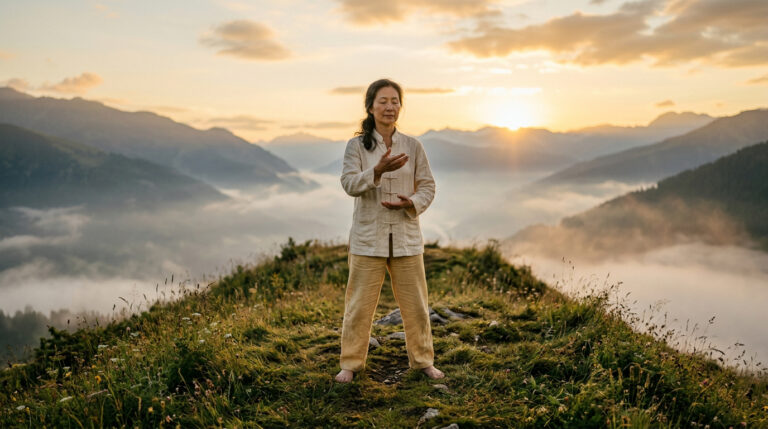
3. Gather inward (about two minutes). Keeping the slow breath, raise both hands out and up on an in-breath as if drawing something in from around you, then turn the palms down and let them sink slowly past the face and chest to rest low on the belly on the out-breath — as though drawing warmth and energy down into that lower centre and closing your hands over it. Feel the movement collect inward and settle, rather than reaching out and up the way a summer stretch does. Six to eight slow rounds is plenty.
Finish by standing or sitting still for a few breaths with the hands resting low on the belly. Most people notice the heaviness has lifted a little and there is a quieter, steadier kind of energy underneath it. That small, immediate change is the point — repeated each afternoon as the days shorten, it is how you move with autumn instead of dragging behind it.
Small adjustments that help as the light draws in
The practice does the main work, but a few ordinary habits keep the darkening season from getting ahead of you. Go to bed a little earlier than you did in summer — autumn is the season for taking rest early, and the body does its gathering-in while you sleep. Ease off the very late nights and the heavy evening screen time that keep you spending when the season wants you settling. Keep some gentle movement in the day so the energy circulates rather than pooling into heaviness, but let it be steady and unhurried rather than the hard, sweaty effort that suited the summer. And eat a little warmer and a little more nourishing than you did in August, leaning toward cooked, settling foods as the evenings cool.
None of this is about doing more. Autumn is the one season that rewards doing less, earlier, and more quietly. The tiredness you are feeling is simply the invitation to change gear — and once you do, the darker months become far easier to move through.
Feeling the season turn is the perfect moment to start a short daily practice. The Onenergy app has free five-minute seasonal routines like the one above — settle into autumn with a few quiet minutes each day. Open the app to begin.
Related reading:
- Dry Throat and Dry Skin in Early Autumn: Why It Happens and a Simple Qigong Practice
- A Simple Daily Qigong Routine You Can Actually Keep
- What Is Qigong? A Plain-English Guide