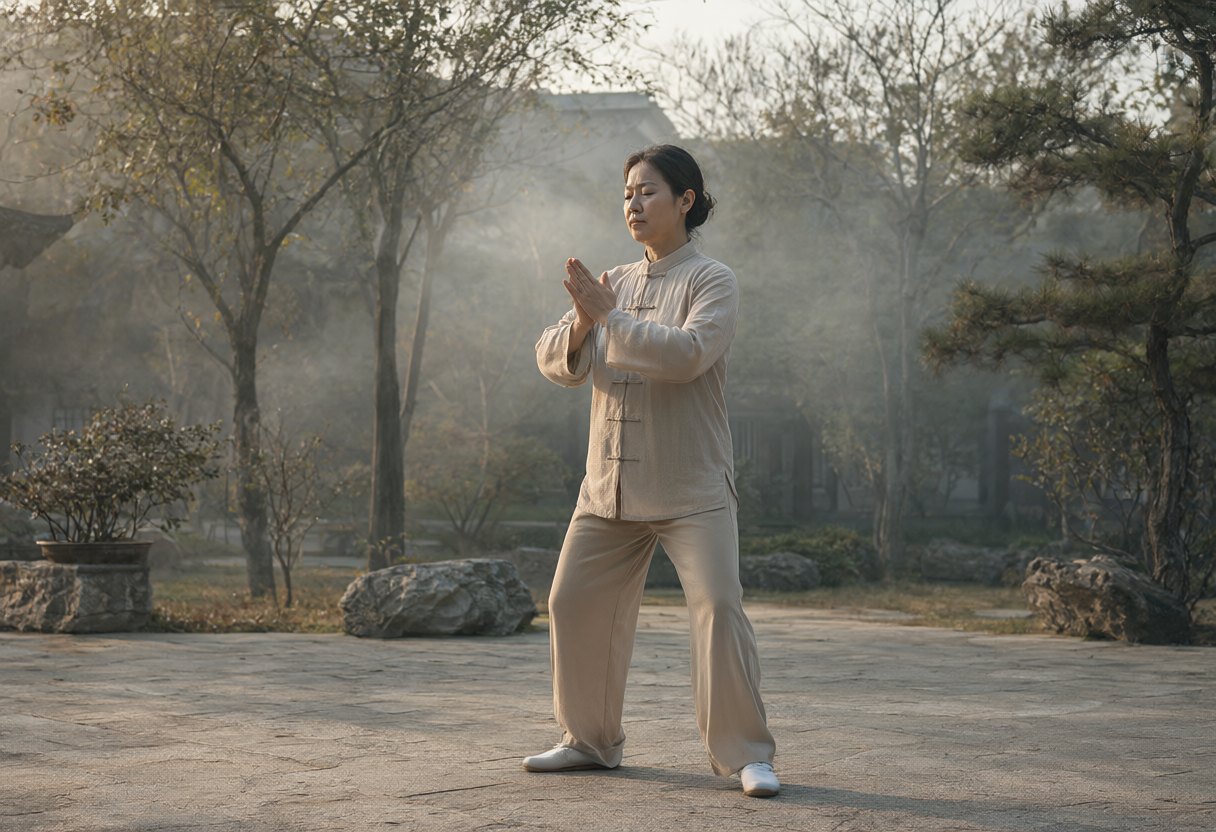

5 Rules to Practise Qigong Safely
Qigong is safe, and qigong is sharp — the sharpness is why it works. Five plain rules keep a real, effective practice from becoming a rough one: don’t force, don’t chase sensation, don’t practise exhausted, close what you open, and slow down when something feels wrong.
 By Onenergy Qigong Institute
In this article
Qigong is safe, and qigong is sharp — and the sharpness is exactly why it works. A dull practice would not move energy at all. The goal is never to blunt qigong into something that does nothing. The goal is to learn how to handle something real, the same way you already handle a sharp kitchen knife every day without a second thought: with respect, not fear. Here are five plain rules that make that possible.
Rule one: don’t force
Forcing rarely feels like forcing while it is happening. It feels like commitment — the morning you finally decided to take practice seriously. But qi does not answer to pressure. It answers to attention. Holding your breath until your chest hurts, clenching your stomach to hold a posture, straining to feel something in your palms and then straining harder when you feel nothing — none of this moves energy any faster. It only tires the body. A simple check catches most forcing: notice your jaw, your shoulders, your breath. If any of them are tight, let them go and keep practising. It costs nothing to check, and you can check on any morning of your life.

Rule two: don’t chase sensation
Heat in the palms, tingling, a wave moving up the spine — these sensations come and go, and they were never the actual point of practice. A student who starts chasing a particular sensation will, without meaning to, start forcing in order to produce one. That is often how a genuinely dedicated student ends up straining. Sensations are information, not a scoreboard. Let them come or not come, and keep the attention on the practice itself rather than on what you hope to feel.
Rule three: don’t practise exhausted
If you have not slept, if you are unwell, or if you are simply drained, that is not the morning to try to raise a large amount of energy. The better move is to do less. A short, easy practice on a difficult day is worth more than a long, demanding one forced through on a day the body does not have the reserves for it. Qigong is not a test of willpower against your own state — it works with your state, not against it.
Rule four: close what you open
Every practice needs an ending, not just a beginning. Most instruction — videos especially — shows you how to open a practice: how to stand, how to breathe, how to move. Very few show you the closing step, where the energy you raised is brought back down and settled, often into the lower belly, before you return to your day. Skip this step and you can walk around the rest of the day feeling scattered, unusually tired, or oddly unsettled that night, even though the practice itself felt fine. Close every practice, even a short one. You would not leave a car engine running in the driveway overnight.
Rule five: slow down when something feels wrong
The moment something feels wrong — a pressure that will not ease, a sensation that feels off rather than simply unfamiliar — the right response is to slow down and ask someone who actually knows, not to push through it to prove commitment, and not to wait several weeks hoping it resolves on its own. If a feeling in the head lasts for days, stop the specific practice that produced it and speak with a qualified teacher rather than searching a forum. And if anything about your health concerns you, that question belongs with your doctor — practice and health are related but separate questions.
Why the rules make qigong safer, not scarier
None of these five rules exist to make qigong sound dangerous. They exist because qigong works with something real, and anything strong enough to move energy in you is strong enough to be handled with a little skill. Learning these rules is not what makes qigong risky — it is what makes qigong safe, and it is what turns a practice you might otherwise stumble through into one you do with real confidence.
Keeping the rules without overthinking them
Five rules are easy to write down and easy to forget in the middle of an actual practice, especially early on when there is already a lot to hold in mind — the posture, the breath, the sequence of movements. It helps to know that these rules are not meant to be recited before every session. They are closer to habits that settle in with repetition, the way a driver eventually checks mirrors without consciously deciding to.
If only one rule has to be remembered on a given day, closing the practice is the one that matters most, because it is the step most often left out entirely by instruction that never mentions it. The other four are mostly about how you carry yourself while practising — softening a tight jaw, letting go of a sensation you are chasing, scaling a practice down on a hard day, pausing when something feels wrong. All of them point toward the same underlying idea: qigong asks for attention, not effort, and a relaxed, attentive practitioner gets further than a strained, determined one.
The lessons inside the Onenergy App are taught in order, with the closing step built into every practice from the start. Open the free Onenergy App and start with a lesson built for exactly where you are.
Related reading
- Why You Can’t Learn Qigong From Videos Alone
- You’ve Been Practising Qigong Your Whole Life Without Knowing It
- What Is Qigong? A Complete Guide