
Why Your Symptoms Started Years Before Your Numbers Went Bad
If you have been feeling sick but your tests are normal, the reason may be that the system your doctor measures is not the one that failed first.
 By Onenergy Qigong Institute
In this article
You felt it years ago. A slow drain. A heaviness in the mornings that coffee could not lift. A body that used to recover in a day now taking a week. You went to the doctor. You asked for the full panel. The results came back, and every number sat inside the normal range. The doctor told you to sleep more, reduce stress, come back in six months.
You are living in one of the stranger positions modern medicine produces: feeling sick but tests normal. The labs are not wrong. The doctor is not dismissing you out of indifference. The problem is structural. The instruments Western medicine uses to measure health watch one part of the body with great precision — and have no tool at all for the part that fails first.
The timeline nobody draws for you
Think back over the last ten years. When did you first notice something was off? Not a diagnosis — just a feeling. A shift in your baseline energy. The point at which a full day began to cost you more than it used to.
For most people that moment comes years before any blood test shows a problem. They adapt. They cut things from their schedule. They reach for caffeine earlier in the morning. They tell themselves it is stress, or age, or the season. The numbers stay normal. So nothing is officially wrong.
The reason this gap exists — between how your body feels and what the instruments detect — is that the instruments are watching the wrong river.
Two rivers, and which one fails first
In traditional Chinese medicine, the body’s circulation runs on two systems. The first is blood. Western medicine has studied this river for centuries. Today it measures its chemistry, its cell counts, its hormone levels, its inflammatory markers with extraordinary precision. A blood panel is a detailed report on the state of this one river.
The second river is qi. It runs through its own network of channels — parallel to blood, connected to blood, but distinct from it. Western imaging was not built for these channels and cannot see them. This is not a failure of modern medicine; it simply was not the focus of that tradition. Chinese medicine has studied the qi river for five thousand years, and the tools for reading it are different: pulse diagnosis at the wrist, observations of the tongue, attention to where heat and cold pool in the body.
In Chinese, the word for circulation combines both rivers into one term — 气血, qi-blood. They move together. They affect each other. And they fail in a specific order.
First the qi weakens. Then, slowly, the blood shows it.
Qi flow slows. Qi pools where it should not. The reservoir of qi the body draws on through the day drops. This happens quietly, over months and years, inside a system Western medicine has no instrument to measure. The blood numbers during this period can look entirely fine — because the blood river has not been affected yet. The upstream failure has not reached it.
Then, eventually, when qi has been weak long enough, the blood river begins to reflect the problem. A number shifts outside its range. Now the doctor can see something. Now there is a disease to name and manage.
By then, the qi has been failing for years.
The chest-pain case
This is not an abstract timeline. Master Dai has told one version of a story that makes it concrete — and it is worth sitting with carefully.
A man in his fifties goes to the emergency room with chest pain. The hospital runs everything: EKG, blood enzyme panels, imaging. Every number comes back clean. The doctor tells him the results look good, prescribes something for the pain, and sends him home.
A few hours later, the man is dead.
The bloodwork was accurate. The numbers really were in range at that moment. The doctor was not lying.
And the man is still dead.
The point of this story is not that Western medicine failed the man — it is that the instruments Western medicine uses are designed to read one river. At the moment the blood was drawn, that river looked normal. The qi system, which had very likely been deteriorating for a long time, had no tool watching it. There was nothing in that emergency room that could see it.
Most people reading this are not in that man’s situation. Most people have the quieter version: years of low-grade drainage, of functioning below their actual capacity, of a body that the system calls fine while the person inside it knows otherwise. The cost is different — not sudden, but cumulative.
What this means for the years you have already lived
If you have been experiencing symptoms before any diagnosis — fatigue, brain fog, slow recovery, a general sense that something is off — the qi framework offers an explanation that the blood-river model cannot. Your qi system may have been weakening for years while the blood numbers held. The feeling was real. The instrument just was not measuring the right thing.
This is worth understanding not to assign blame to the medical system, but to know what it can and cannot see. Western medicine is the right tool for emergencies, for detecting disease once it reaches the blood river, and for treating conditions that have already formed. It is not built for the upstream work — the daily maintenance of the system that fails first.
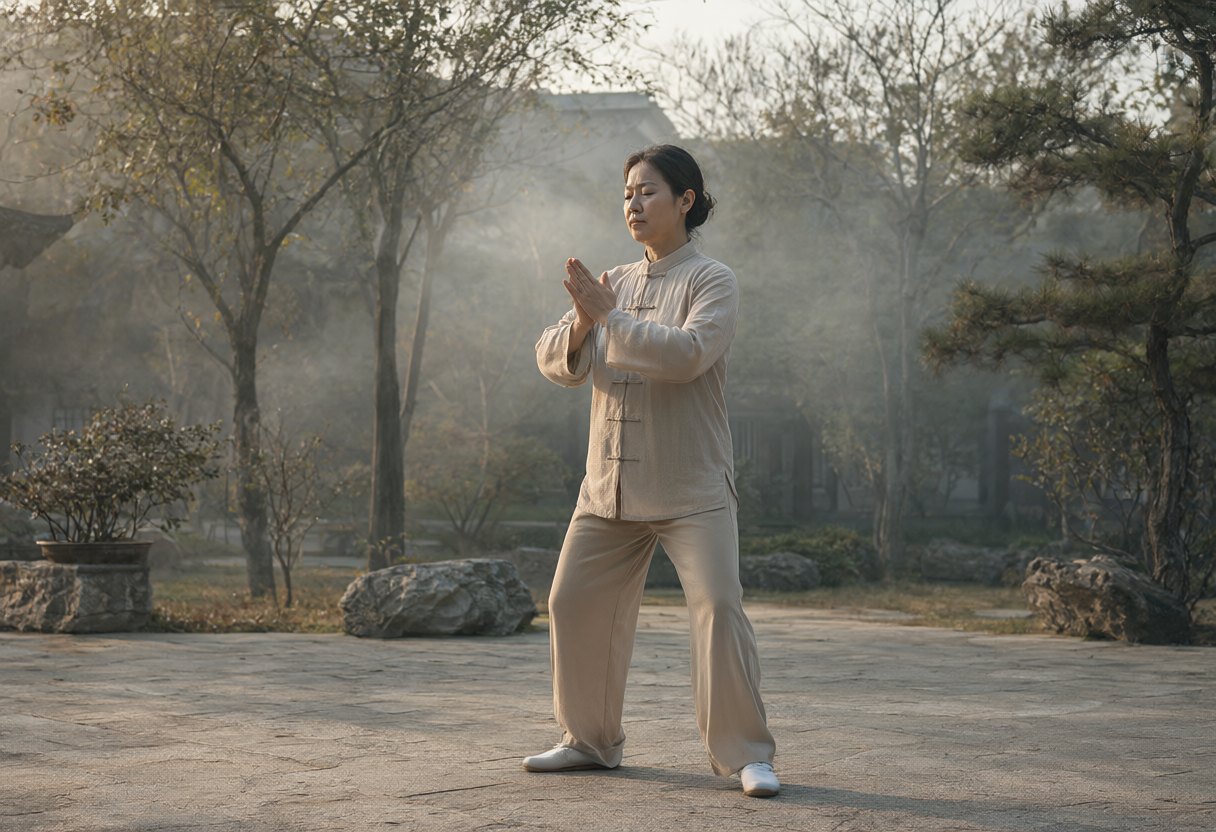
That upstream work has a name. It is qigong. Practiced daily, it works directly on the qi river — building its flow, circulating it through the channels, keeping the reservoir from dropping before any blood number shifts. This is real prevention in the technical sense: work that happens before there is anything to detect.
You verify it in yourself
The two-river framework is not something to take on faith. It is something you can explore in your own body over time. When you begin a consistent daily qigong practice, the first changes tend to be felt before they are measurable: a steadier energy through the afternoon, a calmer baseline, sleep that is actually restorative. The blood numbers may catch up later. The felt experience comes first — because the qi river changes first.
You verify it in yourself. That is the only honest way to know whether this explanation fits your life.
If you want to begin that exploration, the Onenergy app offers daily guided qigong practices you can follow at home. The practice is short enough to hold, consistent enough to build on, and accessible whether you have never tried qigong or have tried it before without finding the right instruction. The app is free to download. Start with one practice. Notice what happens in your own body across a week.
Master Dai also holds a live free event called the Onenergy Manifesto, where he walks through the full picture of the two rivers, what daily practice actually looks like, and what he has built for people who want to do this work seriously. If today’s reading resonated, that event is worth your time. RSVP through the Onenergy app under Upcoming Events.