Can You Do Both Qigong and Yoga Together?
Yes — qigong and yoga sit fine together. But before you combine them, it helps to know what each one is actually doing for you, so you are not surprised by where each one takes you.
 By Onenergy Qigong Institute
In this article
If you already have a yoga mat rolled up in the corner and you are wondering whether adding qigong means giving something up, here is the short answer: can you do qigong and yoga together? Yes. Nothing about one blocks the other. But “yes, you can” is not quite the same question as “what happens when you do” — and that second question is worth sitting with for a minute, because these two practices are not aiming at the same place.
Can you do both qigong and yoga? Yes — here is why they do not conflict
Real yoga and modern qigong grew out of different traditions, asking different questions. Yoga, rooted in ancient Indian spiritual practice, asks: how does the spirit free itself from the body entirely? Qigong, rooted in Daoist tradition, asks: how does a human being become whole and strong, rising to the highest form of a human life without ever leaving it? Neither practice was built to interfere with the other. They are not two versions of the same tool competing for the same job. They are two different tools, built for two different jobs — which is exactly why they can sit together without friction.
Think of it this way: someone can strength-train and also study a musical instrument. The two are not enemies. They just are not doing the same work, and getting good at one does not require abandoning the other.
What each one is actually doing while you practice
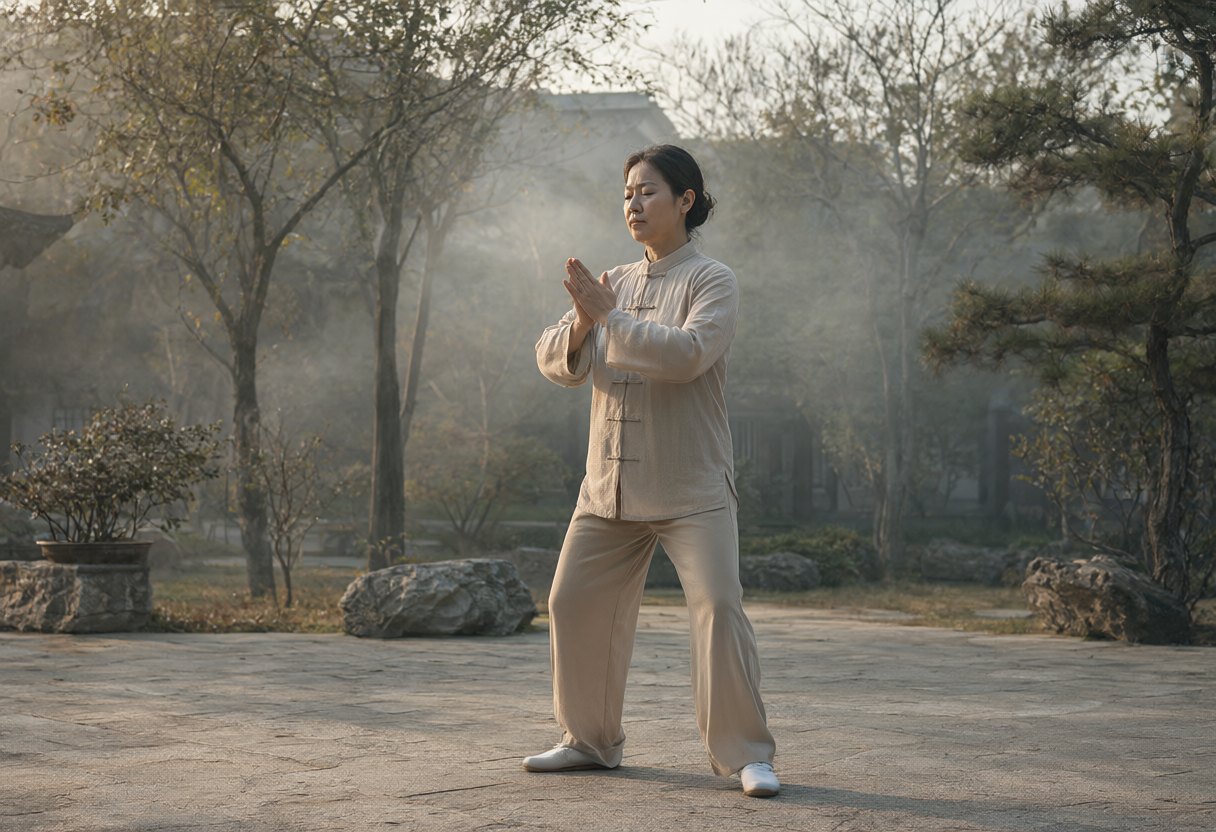
When you practice real yoga, the postures and breathing exist to prepare the body to sit still, comfortably, for long stretches of inner work — the deep tradition describes energy rising gate by gate toward release. When you practice qigong, the movement and breath exist to build and circulate qi, strengthening the body and steadying the energy that runs it — the foundation the whole practice is built on. Different mechanics, different aims. You can do both in the same week, even the same day, without either one undoing the other.
What changes if you practice both — and what to actually watch for
The one thing worth being honest with yourself about is expectation. If you are doing yoga hoping it will build your long-term health and vitality the way qigong is built to, you may find yourself waiting on a result the practice was never aimed at delivering directly — it will still give you flexibility and calm, real and worth having, just not as its central target. And if you are doing qigong hoping for the spiritual release that real yoga’s tradition describes, you may find that qigong keeps pointing you back into a strong, rooted life rather than out of it — because staying, not leaving, is the whole design.
None of that is a problem with either practice. It is just useful to know which one you are leaning on for what, so you are not surprised later by where each one actually takes you.
A simple way to hold both without confusion
Some people use yoga for flexibility, breath, and quiet, and use qigong as the practice they are building their long-term health and energy on. That combination works well precisely because it respects what each was built for, instead of asking one practice to do the other’s job. You do not need to rank them against each other. You need to know, session by session, what you are asking each one to give you.
And whichever combination you land on, the test is always the same: you verify it in yourself. Not by which practice sounds more impressive, but by what actually changes in your own body and energy over weeks and months of showing up.
If health and energy are what you are building toward
If part of why you are combining the two is that you want a stronger, more energized, longer, more vital life — that goal has a practice built directly for it. The free Onenergy app offers guided qigong practice you can fold in alongside anything else you already do, at a pace that fits a real life rather than a retreat schedule. No need to choose one tradition and abandon the other — just be clear-eyed about which one is carrying which part of the work. The Onenergy Way program and live community events go further for anyone who wants to build that foundation seriously.